


Look who’s peeking out of the Disney Animation Building? It’s Hiro and Baymax!!! Can you tell we were excited to see them? We were jumping for joy!
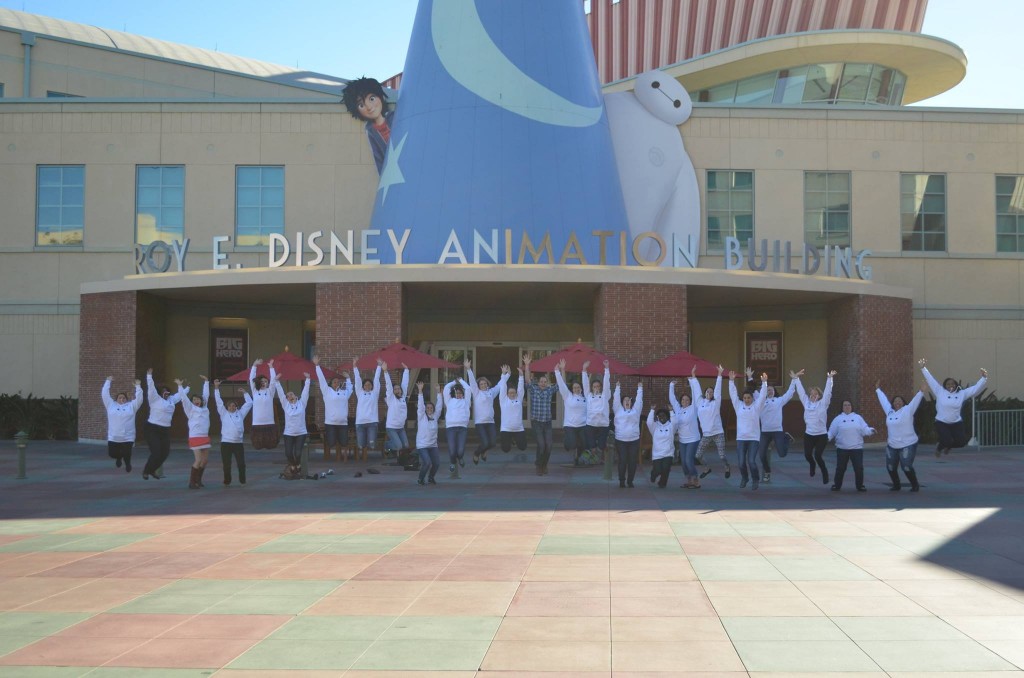
They were there visiting and so were we. They of course had the better view…or did they? Nah…we actually got to go inside and get an inside look at Big Hero 6 and now you get to read the scoop.

On to the inside scoop, check out my interview with directors Don Hall and Chris Williams
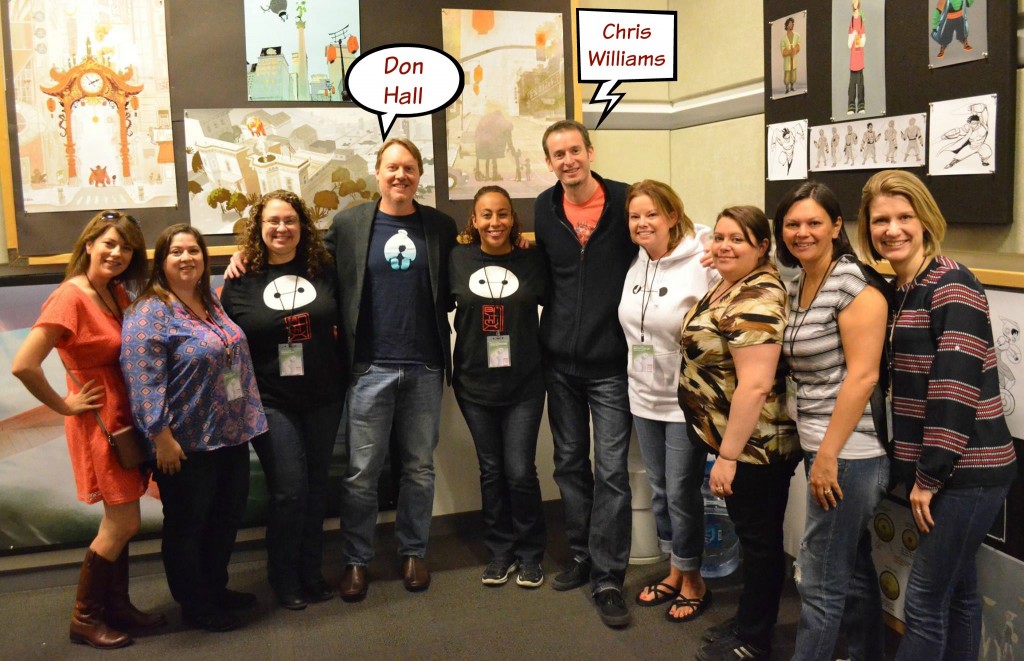
Big Hero 6 is [originally a] small publication in the comic book world. What attracted you to the story of Big Hero 6?
Don Hall: that certainly helped. What originally attracted me to Big Hero 6 was just the title. It just sounded interesting. Then, I researched it a little bit more and I saw the Japanese superhero theme, thought that was super cool, and then read the books and I was really struck by the characters. They were just so fun. They were fun and appealing characters. They had goofy names, like Honey Lemon and you could tell that the creators loved Japanese pop culture, and that’s why they did the book. They wanted to take their sort of love and anime and all things Japanese, and infuse that with a sort of Marvel superhero story. So, I love that.
But most of all, we could see amidst all of that there was an emotional story about a 14-year old super genius who loses his big brother and the robot that becomes a surrogate brother and heals him.
Chris Williams: I remember pretty vividly, about three, three and a half years ago. Don and I did a pitch in this room, on that wall, of Big Hero 6, and, you know, it was real skeletal, like a broad-strokes summary of what it could be.
At that stage, you’re not looking at every character, every scene. You just have to show the potential for a fun story and everyone was really taken with the idea of a kid who was going to lose his brother and who would be left with his brother’s robot, a surrogate big brother, to help him move on. That just struck a chord with everybody. So it was my favorite.
I was really glad when John Lasseter green-lit it. The fact that it was an obscure property really helps us, because we’ll sit at this table and talk about [the movie we’re making] for years. It evolves quite a bit, and we have screenings and the story changes a lot. We know whatever we start out with, it’s going to end up being something different.
The fact that Big Hero 6 wasn’t a well-known property where people were going to have their own idea of what it should be really helped us.
What was the biggest change from the initial script to the final cut of Big Hero 6?
Don Hall: It may not be the biggest, but one thing that comes to mind is that Baymax became more central. We realized that when Baymax was driving the story and the plot it really helped. So Baymax became a real interesting character in uniting the “boy and his robot” story and the superhero origin story.
Chris Williams: I don’t know if that’s the biggest, but I think it’s the most significant. Because up to that point, Hiro was really driving the story. Which makes sense. You’d want the protagonist driving the story, but the story wasn’t coming together. It didn’t come together until we put Baymax front and center and really put the idea that he wants to heal Hiro at the forefront.
If you look at it, it’s a little sneaky, but Baymax is the one that’s really kind of pushing the story forward. He’s the one who brings the friends in, and he’s the one that furthers the flight because it’s making Hiro feel good and forget the loss of his brother for a little bit. Once we did that, the story really started.
Who’s your favorite character is in the movie, and why?
Chris Williams: We should probably disqualify Baymax…That’s too [LAUGHTER] easy…I identify a lot with Fred. He’s really a dork and a geek and all into monster movies and sci-fi. I can identify with Fred, and there’s moments for Fred, during the superhero shenanigans part of it, I keep remembering the feeling that I had when I was a kid and we played superhero, and I had the trash can lid for a Captain America shield …there was a feeling, and that’s how I feel like Fred approaches this whole thing…For him, it’s just, “I get to play superhero as an adult.”
Did you study any specific Marvel action scenes from the movies to inspire any of the scenes from this movie?
Chris Williams: I can’t say we did. Well, I wouldn’t say we studied but we’d seen the movies so many times that we’re all just big geeks, so, you know, we probably knew them more than we should. We definitely wanted to do right by the action part of it but the emotional story is the most emotional thing, you know? But we also felt that there was going to be an expectation that the action scenes had to be pretty awesome. Not only that, but they had to have a different personality.
I guess that’s one of the things that I’m most proud of, that they all moved different.
The scenery in Big Hero 6 is really exciting and mesmerizing, and there’s so much to see. How did you go about researching what the actual backgrounds would be, and how much attention you wanted to draw to the backgrounds?
Chris Williams: We put a stake in the ground very early on, saying we’re going to push the lighting. We want this to have a very cinematic look. That was by design. So we had some rules that governed our art direction: Simple characters on a complex background.
There’s more detail in this movie than in the last three movies, I think. That’s a credit to our production designer, Paul Felix, and our art director, Scott Watanabe, who really shared the burden of how to integrate the Japanese stuff into San Francisco.
Not only that, we had to make it seem like a lived-in, real place. Not a soundstage or a CG-ish environment.
Don Hall: We have an incredible production designer and art director. They really go to these places, they immerse themselves, they sketch, they take pictures, they study. That’s how you get all of the details that add up so it feels realized, so that it feels really complete.
These guys go really deep. Even the placement of the sun in the sky; the sun will always be in the right place in the sky, depending on the time of day in the scene and the geography of San Francisco.
Instead of making the setting completely fantasy or completely real, how did you come up with the combination of Tokyo and San Francisco?
Chris Williams: It happened very early, because that’s the first thing we generally tackle. Before we ever go into story, it’s always the world first.
In our second meeting with Marvel, we talked about this. [Marvel] said, “You don’t have to worry about setting this in the Marvel Universe. Don’t worry about trying to integrate Captain America and Iron Man. Just take this and go. Make your own world.”
That was very freeing, but it left a lot of questions. What is the world? How were we going to integrate a Japanese stamp. San Francisco just felt cool because it’s very recognizable.
It’s a contained city. It’s a beautiful city, and there are so many things people recognize. Like the Golden Gate Bridge, cable cars and the topography. It just felt like we could make a grounded, relatable world but still have the fantasy that we do in animation.
Don Hall: Something John [Lasseter] emphasizes a lot is that the story is going to change a lot, but you’re going to live with the world you create. Before we created the story, we did a lot of research just to build the world. We let the world inform the story.
While we there we got to sit down and learn how to draw Baymax. How did I do? Do you think they’ll be hiring me anytime soon?
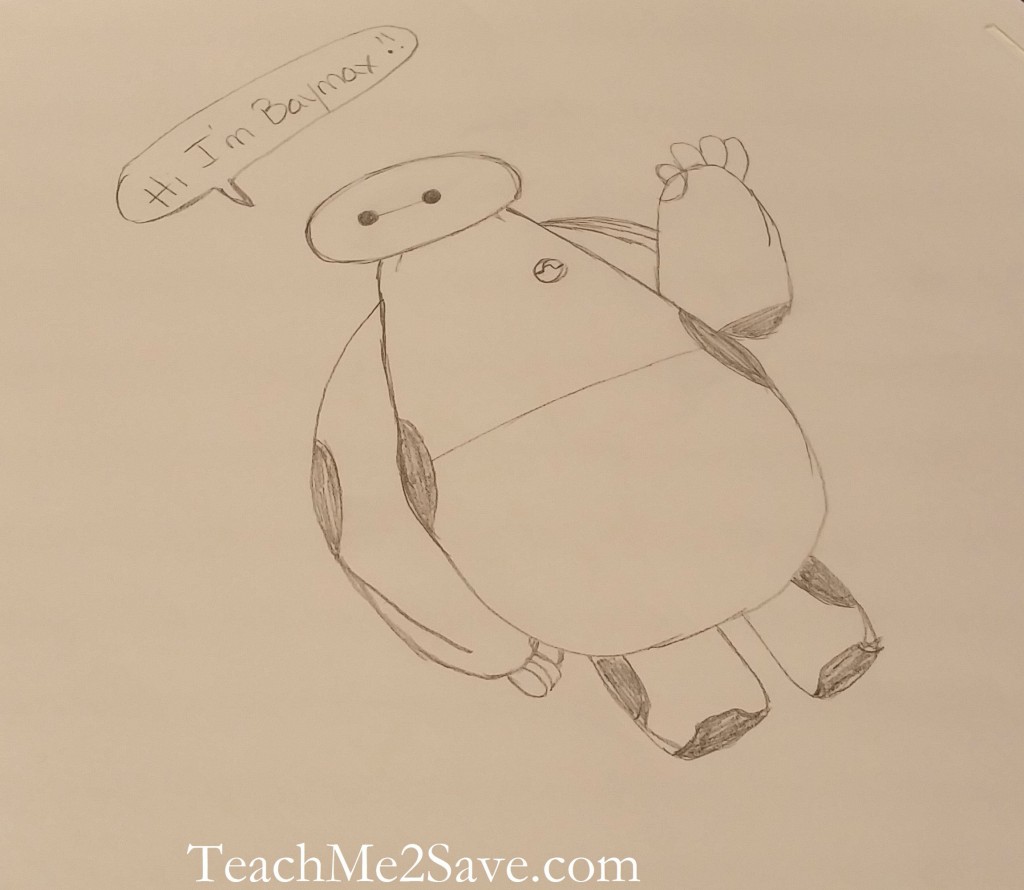
I also got to record a scene from the movie, Big Hero 6, but you’re going to have to check back for that later this week because that merits a post of is own.
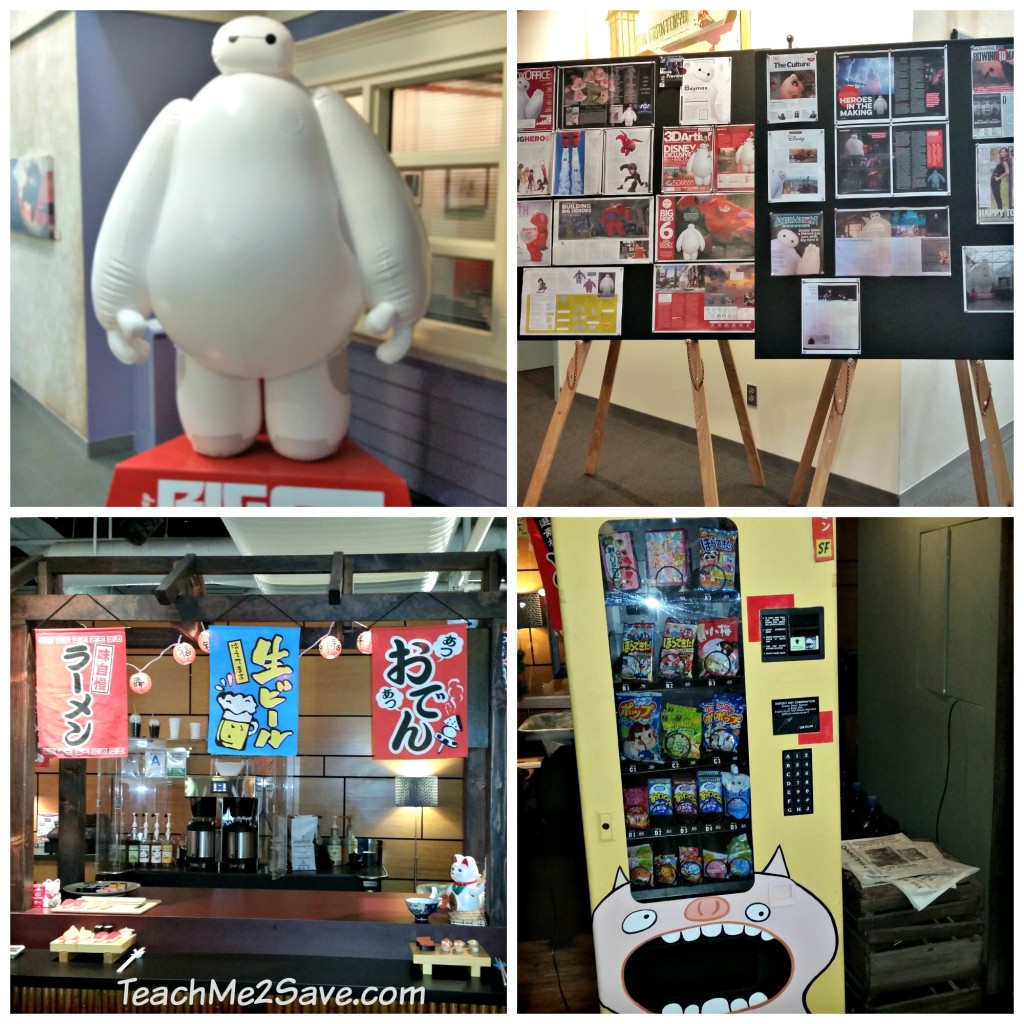
On a side note…One thing I love about Disney is that they always go all out. Even their lunch area and offices are transformed to reflect their latest movie project.
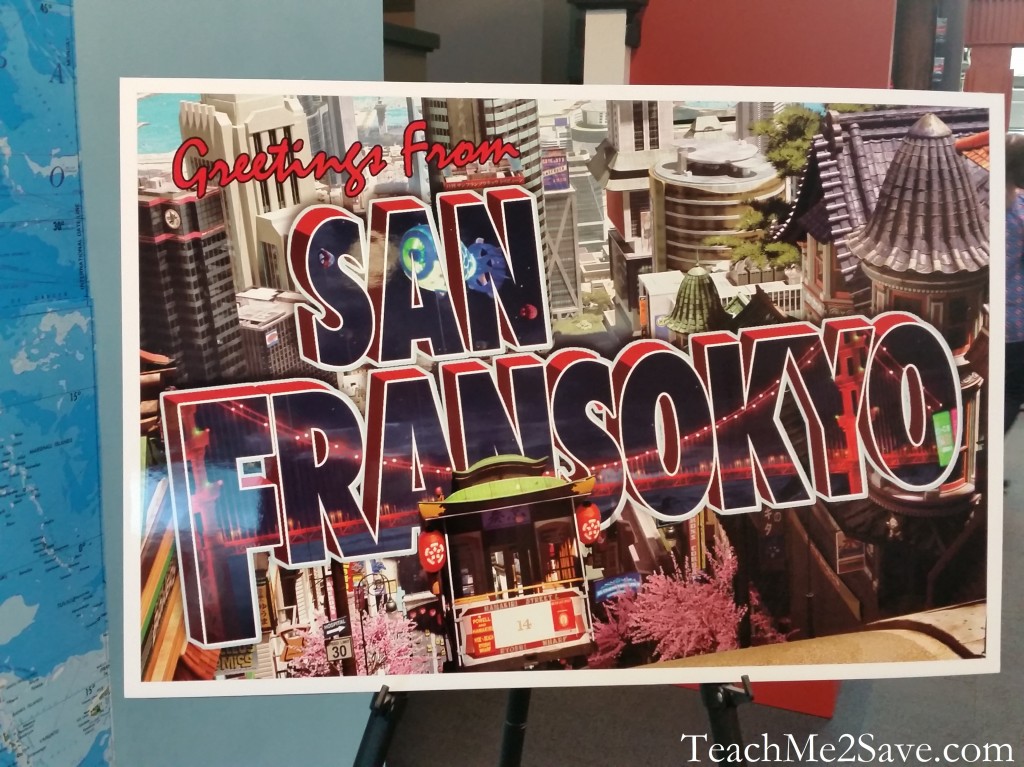
When they say “Welcome to San Fransokyo”, they mean it. It’s like you’re there.
It was an amazing day! Can you see why we were jumping for joy?


